President-Nation-Address-South-Africa-21-Day-Lockdown

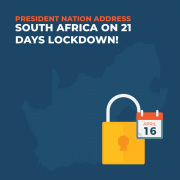
NEWS | UPDATE: PRESIDENT NATION ADDRESS – SOUTH AFRICA ON 21 DAYS LOCKDOWN!

Inter-alia with the lockdown of the country from midnight 26 March 2020 up until midnight 16 April 2020, he has strengthened the precautionary measures of South African residents and other foreign travellers who are travelling, or have been travelling through South Africa prior to his initial announcement –

1.South African Citizens and residents arriving from high-risk countries will automatically be placed under quarantine for 14 days.
2.International flights to Lanseria Airport have temporarily been suspended.

3.International travellers who arrived in South Africa after 9 March 2020 from high-risk countries will be confined to their hotels until they have completed a 14-day period of quarantine.


Those who are still intending on arriving in South Africa on flights from high-risk countries, can expect to be turned back and will not be allowed to enter South Africa.

There will an inter-ministerial meeting on the morning of 24 March 2020 to discuss and outline the President’s additional measures.

“The nation-wide lockdown is necessary to fundamentally disrupt the chain of transmission across society.” – President Cyril Ramaphosa

More updates will be shared in due course.

Corona-Virus-Mozambique

NEWS | CORONAVIRUS MOZAMBIQUE CLOSES SCHOOLS, SUSPENDS VISA ISSUANCE – PRESIDENT

The President also announced that the country will close all private and public schools, suspend visa issuance and revoke previously granted visas and ban public or private gatherings of more than 50 people except those of national interest, such as parliament sessions.

The mandatory home quarantine was previously applied only for citizens, Mozambicans or foreigners,  arriving  from designated countries but it  now applies to any traveller entering the country.

Meanwhile, a technical-scientific commission to advise the Government in making decisions about the pandemic, will be created.

The government will also strengthen  monitoring.

The closure of schools cover all educational establishments in the country, from kindergarten to University.

The President further  informed that no confirmed cases have been recorded so far in Mozambique, adding that there is no record of confirmed cases among Mozambicans in the diaspora either.

President Nyusi underlined that prevention is key in a country with our characteristics, calling on all, namely the Press, to support and convey these measures and other related information supplied by the health authorities.

Although no cases of the respiratory disease Covid-19 have yet been detected in Mozambique, the government has decided to step its preventive measures, notably by shutting down all the country’s schools.

Addressing the nation on television and radio on Friday afternoon, President Filipe Nyusi said all schools, whether publicly or privately owned, and teaching all levels of education, from pre-school up to university, must close for 30 days as from next Monday.

The restriction on meetings has been tightened, on Saturday the government announced a ban on all gatherings of more than 300 people. Nyusi’s Friday announcement brought this limit down to 50.

He made it clear that this restriction applies to all meetings, including religious services. AIM is aware of some churches in Maputo which disregarded the earlier ban.

There will be exceptions from the ban for state events, such as the forthcoming sitting of the Mozambican parliament, the Assembly of the Republic, which is due to begin on 25 March.

Nyusi said the government will ban the issuing of entry visas, and cancel visas that have already been issued. He said nothing about citizens of countries who do not need entry visas (mostly other members of the Southern African Development Community, SADC).

All travellers entering Mozambique must go into quarantine for 14 days. Previously, this only applied to travellers arriving from countries with high rates of Covid-19 infection. By Thursday, the list of such countries had reached 20, namely: China, Italy, Iran, South Korea, Germany, France, Spain, Switzerland, Denmark, United States, United Kingdom, Holland, Sweden, Norway, Portugal, Greece, Belgium, Pakistan, Austria and Canada.

The Health Ministry had promised to update this list every day, but that will hardly be necessary, if everybody arriving in the country is to be quarantined.

Nyusi said that preventive measures must be taken in all public and private institutions. Many institutions are already obliging their employees and workers to wash their hands, and are regularly disinfecting surfaces.

The President also announced the creation of a technical and scientific committee, headed by Health Minister Armindo Tiago, which will accompany the development of the pandemic and advise the government. The commission will include not only health experts, but other scientists, and media professionals.

Nyusi announced that 35 suspect cases had been tested for the coronavirus and all proved negative. Similar there have been no reports of any Mozambicans living in the diaspora becoming infected.

To keep Mozambique free of the virus, “prevention remains the best strategy”, stressed Nyusi.

Source: Club of Mozambique

Foreign Nationals are Urged to Make Use of Visa Concessions To Remain Compliant in SA

NEWS | FOREIGN NATIONALS ARE URGED TO MAKE USE OF VISA CONCESSIONS TO REMAIN COMPLIANT IN SA

The department issued a directive that allows for the extension of all Chinese nationals in SA whose visas are about to expire to remain in the country until 31 July.

The department this week issued a further directive which covers foreign nationals from all medium and high-risk countries, allowing them to extend their visas until 31 July. This is also applicable to foreign nationals who will have to travel through a high-risk country to their country of origin.

Marisa Jacobs, director at Xpatweb and head of immigration and mobility, encourages foreign nationals to apply for the extension or renewal of their visas to remain compliant. “Do not use the coronavirus as an excuse not to take the necessary measures to remain compliant. There are concessions – make use of them.”

She says their client base is largely multinational companies with foreigners working in SA. This include critically skilled or executive level individuals as well as technical project-related foreign nationals. They have been concerned about their position should their visas expire. “They would normally have travelled back to their home countries, but with the ever-increasing travel bans this is not an option at this stage.”

Jacobs says there are also several instances where companies have resources that are due to enter SA to start on projects or assignments. “Many are not able to enter the country anymore due to the travel bans, or they are no longer able to obtain a visa.”

Several embassies where visa applications for entry into SA have been pending, have in recent days sent out notices that they will be closing their offices and they will no longer process applications. People have been asked to collect their passports. The situation is completely fluid at the moment. An embassy that is open today, can be closed tomorrow, she says.

Xpatweb has received notices from embassies in the UK, Canada, Qatar and Sweden indicating that they will no longer process visa applications. However, the embassy in China has remained open.

“We are advising people who are due to travel to SA to submit their applications as soon as possible if their embassies remain open and they are processing applications,” says Jacobs.

In practice not all travel can be avoided. Jacobs says they have found the Department of Home Affairs to be quite sympathetic and has been willing to make exceptions when it is critical for people to travel to SA. Jacobs advises people who have to travel urgently to ensure their flight bookings and accommodation are open-ended or changeable.

“We foresee more restrictions in the coming weeks from everywhere. People need to be pro-active, and although most people will restrict their travel as far as possible there will be instances where travelling cannot be avoided.” People who have travelled and are stuck because of travel restrictions should contact their embassies.

The department of home affairs has been extremely helpful with information and their efforts to accommodate people, says Jacobs.

Civic Consular and Immigration Update SA Embassy Abu Dhabi

NEWS | CIVIC, CONSULAR AND IMMIGRATION UPDATE: SOUTH AFRICAN EMBASSY ABU DHABI

Certification / Verification of Copies of Original South African Documentation

  • Deliver original documentation on Mondays – collect on Wednesdays
  • To submit relevant original South African documentation and applicants’ original passport as well as letter indicating purpose of the request in a sealed envelope with applicant’s full names, contact number and email address on the outside.

Civic Matters (application for birth certificates, ID’s, marriage certificates, passports, police clearance certificates)

  • ONLY Wednesday with prior appointments – email request to dha@dirco.gov.za – Embassy will respond with next available appointment.

Commissioner of Oaths – Authentication / Attestations

  • ONLY Mondays with prior appointments – email request to dha@dirco.gov.za – Embassy will respond with next available appointment.

End User Certificates

  • Deliver original documentation on Mondays – collect on Wednesdays
  • To submit relevant original documentation and original Company’s letter indicating purpose of requests.

Permits and Visas

  • NO applications will be considered for non-essential visits until further notice
  • EMERGENCY applications – applicant to email copy of applicant’s passport, applicants employer’s letter (NOC) and South African invitation to dha@dirco.gov.za – if approved applicant will be provided an appointment to submit documentation.

Travel Consent

  • ONLY Mondays – email copies of father, mother, children’s passports, children’s unabridged birth certificates and confirmed flight reservations to dha@dirco.gov.za – Embassy will respond with next available appointment.

Any Other Matters

  • Email requests to dha@dirco.gov.za – Embassy will respond by e-mail

The South African Embassy apologises for any inconvenience caused but has an obligation to adhere to the guidelines and instructions of the South African Government, the United Arab Emirates Government and the World Health Organisation.

15 March 2020  – Thank you for your understanding and cooperation.

CoronaVirus What Foreign Nationals And Their Employers Need to Know

NEWS | CORONAVIRUS: WHAT FOREIGN NATIONALS AND THEIR EMPLOYERS NEED TO KNOW

Marisa Jacobs, managing director at Xpatweb, described the situation as “uncharted territory”. She answered some practical questions for employers of foreign nationals.

What should be done when the visas of expatriates from high-risk countries expire while they are in South Africa?

Expatriates from “high-risk” countries currently in South Africa, and whose visas are due to expire, are advised to apply for the extensions of their visas, within South Africa to ensure that they remain compliant.

Some of these renewals, such as inter-company work visa renewals, corporate visa holders and those on short terms business visas; are normally not allowed in South Africa; but these are extraordinary times.

Travel to their home countries will mean they will not be allowed to come back to South Africa, as the foreign South African missions in these “high-risk” countries are prohibited from issuing visas.

This is a special process and must be done through the correct Home Affairs channels, and we recommend that employers start this process as soon as possible.

What should be done when the visas of expatriates from medium risk countries expire while they are in South Africa?

Expatriates from “medium-risk” countries currently in South Africa, and whose visas are due to expire, are equally advised to renew within South Africa.

Whilst the foreign South African missions are allowed to process these applications, there is the requirement of a “certificate of clearance from the virus”, which may cause delay. Also, the employer and expatriate run the risk that medium risk countries may be escalated to high risk. Again, we recommend that the Department of Home Affairs should be approached upfront for special dispensation.

What happens when the passport expires of expatriates from a ‘restricted’ country?

Any passports that have expired or are due to expire, may be renewed at the appropriate Consulate or Embassy within South Africa, and visas currently endorsed into an expired or full passport, will require an application for a ‘transfer of visa’ to be made in order for the visa to be endorsed into the new passport once issued. This can be done in South Africa. Expatriates are reminded to ensure that they apply for passport renewals timeously, as any subsequent visa validity depends on this.

What if a new work visa has been acquired, but the expatriate has not entered South Africa yet?

Any foreign national who has visited high-risk countries in the past 20 days will be denied entry into SA; and travellers from medium-risk countries will be required to undergo “high intensity screening” before entering SA.

Foreign nationals from both “medium- and high-risk” countries who used to enter South Africa visa free, will now be required to apply for a visa to be considered entry to South Africa; this application will require inclusion of a health indication with a “certificate of clearance from the virus”.

Contradicting to the above, and subject to further clarification from the Department, work visas that have been issued from these countries, exclusive of China and Iran, and not yet activated through ports of entry, have not been revoked or cancelled. However, these nationals remain banned from South Africa until same has been lifted.

We recommend that an upfront confirmation process be adopted with the Department of Home Affairs or relevant Foreign Mission, as opposed to ‘fingers crossed’ that entry will be allowed.

What about if the expatriate is on home leave, in a ‘medium- and high-risk’ country?

The Minister of the Department of Home Affairs indicated that flights are subject to an “advanced passenger process” whereby a passenger log of each flight is submitted to the Department and undergoes a verification process between the travel origin and connecting flights for each passenger coming to South Africa.

This will undergo further review before disembarkation into South Africa to assess if any passengers may not be permitted to enter South Africa.

We recommend contact is made prior to making travel arrangements to ensure entry into the country will be allowed. Employers and expatriates should take special note hereof and make sure that they get clearance upfront, thus not risk being stranded in a system, currently in a state of flux.

For expatriates about to start the process of new work visas 

Where new resources are required for business and/or for projects purposes, it is recommended that the expatriate, supported by the South African employer, still immediately proceed with the preparation (and filing where possible) of the required work visa application(s) until further instructions have been received by the Department of Home Affairs. No one knows how long these measures will apply and with less travel visas issued; this is an opportune time to start the process.

Though restrictions have been imposed on the travel of foreign nationals from “medium- and high-risk” countries, the actual filing of visa applications have not been impacted in all countries. Understandably, as the economic impact of these restrictions must be limited, so it makes sense to use this period to get necessary approvals now. This prevents being caught in an expected rush later when restrictions are lifted and allows business to get back to normal as soon as restrictions are over.

Special cases: the UK is now closed, China remains open

The VFS office in the United Kingdom is now formally closed, however, China remains open for applications.

Where sufficient business or personal cases exist, employers and expatriates caught by these closures, often immediate and unexpected, can always approach the Department of Home Affairs directly through the correct channels. There is also always a discretion of the South African Embassy, and until clear instructions have been received by them from the Department.

Where applications are being processed, applicants will be in a position to make the required arrangements in order to proceed with travel to South Africa as soon as the travel bans have been uplifted.

Again, it is therefore imperative that applications are not delayed but filed (where permitted) as soon as possible as we expect an influx of applications once the travel bans are uplifted and some advance planning will ensure you are ahead of the rush.

Source: Fin24