NEWS | MORE AND MORE SOUTH AFRICANS ARE EMIGRATING TO MAURITIUS
/in Archived, News /by xp-admin“The island seemingly offers a more stable political and financial climate, and its geographic location and affiliation to the African continent makes it attractive to South Africans”, says Aditi Boolell, Lead Advisory at the Temple Group in Mauritius.
The island is fast paced in its overall growth, seeking to expand its outreach globally and trying to keep up with global trends such as financial technology and blockchain.
“Mauritius may still be a developing country compared to the UK, Australia or New Zealand but it offers sound infrastructure, free public education to its residents and reliable private and public healthcare facilities,” she says.
Jonty Leon, tax attorney at Tax Consulting SA, adds that Mauritius is just “a hop-skip-and-a-jump” from South Africa. This makes it still accessible to the “home of the heart”, but it gives South Africans the benefit of being outside SA’s monetary area for exchange control and tax purposes.
The lack of economic growth, the devastation of state capture and recent talks of using people’s hard-earned savings to bail out badly managed state-owned enterprises are making South Africans looking for safe havens, such as Mauritius, where their assets will be protected.
The options
The three categories of occupation permits are:
- for the person seeking employment;
- for the person looking to be self-employed;
- for the person looking to set up his own company in Mauritius.
Under the Occupation Permit the investment requirement can differ from nothing to $100,000. As opposed to some countries, the immigration regime in Mauritius does not rely on a checklist system but rather determines the eligibility of an application on a case by case basis.
Occupation permits are valid for three years and are renewable upon the fulfilment of certain conditions.
The golden egg – permanent residence
Boolell said there is also an “increasing and urgent” demand from South Africans considering retirement and permanent residence in Mauritius.
People seeking residency on a long-term basis will have to invest a minimum of $500,000. This can be done through the purchase of property under a scheme approved by the Economic Development Board, or through an investment into “qualifying activities”, also approved by the board.
For those skeptical of making a USD 500,000 investment without having experienced living in the country first, there is the option of coming in on the above-mentioned Occupation Permits or on a Residence Permit as a Retired Non-Citizen (where the applicant is above 50 years of age). This would allow the expat to discover living and/or working in Mauritius for a minimum period of 3 years. Thereafter, at the time of renewing their permits, they may make an application for a Permanent Residence Permit subject to satisfying the higher criteria accompanying this application. If the aim of an expat is long-term residency in Mauritius, this should be planned for at the time of the first application itself to make sure that, upon renewal of the permit, there will be no obstacle for an application to permanent residency.
“The purchase of property will also allow an expat to apply for a residence permit which will be valid for as long as that property is not sold to a third party”, Boolell explains.
Investing in a qualifying activity makes the expat eligible to seek a permanent residence permit which will span over a decade.
Breaking ties
Leon advises that once the decision has been made to relocate, it is important for people to follow the right procedures. They need to show that they have no intention of returning to South Africa.
The South African Revenue Service (SARS) will apply both the physical presence test as well as the ordinarily resident test to determine the tax status of individuals who are living and working abroad.
People who have obtained long term residency in Mauritius will have peace of mind that that they are well on their way to not being tax resident of South Africa. Especially where they have formalized their status with SARS and SARB by using the Financial Emigration process.
There is an exit charge in terms of capital gains tax, but immovable property in SA, pension funds, retirement annuities and preservation funds are all excluded from the exit charge, Leon says.
The costs
A main consideration for people wanting to emigrate is the initial relocation costs, as well as the cost of living in a new country.
Mauritius ticks all the right boxes with competitive business set up costs, a more discretionary immigration process rather than strict legal requirements and a quicker route to permanent residency than countries such as the UK, US and even Portugal.

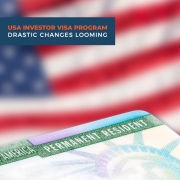
NEWS | UNITED STATES INVESTOR VISA PROGRAM – DRASTIC CHANGES LOOMING
/in Archived, News /by xp-adminEB-5 Investor Visa
The US has run an investor program since 1990 whereby individuals who want to obtain a green card in the US can invest funds in the US while meeting certain requirements, and if met, would be able to subsequently obtain permanent residency and later, citizenship. The program is here to stay, however, requirements are rapidly becoming more onerous on the individual. These requirements officially change on 21 November 2019.
Current State of Play
Before the change in regulation takes place, the investor needs to meet the following requirements to be granted an EB-5 visa:
- Invest $500 000,00;
- Which funds must consist of lawfully obtained capital;
- In a new commercial enterprise, which is noted as an “at risk” investment; and
- Which creates at least 10 jobs for US workers
Change in Regulation
As noted, the regulation around the EB-5 visa is changing from 21 November 2019. All the requirements, except one, from the current regulation remain the same. The difference is that from the effective date of the amendment, the required investment increases from $500 000,00 to $900 000,00 in order to qualify for the program.
For those who have been planning on investing in the US to one day obtain citizenship, it is becoming a whole lot more expensive.
Advantages of the Investor Program
While the obvious advantage of the program is that the investor can obtain permanent residency and later citizenship in the US, the program also provides other incentives, especially where the service provider who assists with the application, is top notch and knows where to invest. Other advantages include:
- The investor does not require an offer of employment in the US or a labour certification application;
- The investor does not require any particular background, education or experience;
- The program extends to the investor’s spouse and their children, who are under 21 and unmarried; and
- Once all conditions are met and the investor receives an unconditional green card, the investment can be returned to the investor.
Act Fast
Taking into consideration the change in regulation, those who intend to settle in the US should consider jumping at the opportunity while it still lasts. With so many fly-by-night organizations punting to provide the service, it is important to perform due diligence and find a reputable provider. Having dealt with South Africans leaving, or considering leaving to the US, means one often needs to understand the options available and find reputable providers in the market for our clients. Should this idea be something one is interested in, I have always been happy to introduce clients to the best in the market – feel free to contact me at jonty@financialemigration.co.za
AUTHOR 
Jonty Leon
Legal Manager – Financial Emigration
NEWS | ICT SKILLS BRAIN DRAIN: IS THERE A SILVER LINING?
/in Archived, News /by xp-adminRecent reports indicate that the South African ‘brain drain’ has gained momentum as skilled professionals look to better opportunities abroad, often driven by concern about South Africa’s economy, crime and other factors. Some reports put South Africa’s brain drain among the highest in the world, with Xpatweb reporting a sharp increase in the number of in-demand skills leaving the country.
In multinational technology and consulting organisations, top South African candidates are increasingly being poached, transferred or promoted abroad within these organisations. Senior people are leaving the country to advance their careers after being affected by retrenchments or forced into early retirement. Not only does this exodus create immediate skills gaps – it also hampers mentorship and development of less-experienced staff.
In many cases, these key, senior ICT resources depart with little notice or time for effective succession planning. In our own organisation, we have seen it taking as little as 6 weeks from a candidate getting an offer abroad, to the time they leave the country.
For the ICT sector, already grappling with a lack of advanced next generation technology skills, particularly in fields such as robotics, AI and data science, this brain drain is leaving a significant skills gap and causing significant concern among companies that urgently need these advanced skills to innovate, grow their organisations and remain globally competitive.
There is a massive skills shortage for true data scientists and big data consultants with experience in HIVE, Spark, Kafka, NiFi and Ranger, to name a few. Many local organisations are seeking to fill gaps by recruiting from countries such as Zimbabwe, Nigeria, Iran and Poland, which offer excellent training in data science and data engineering.
These candidates are typically highly skilled, passionate, driven and demonstrate a hunger for a career in ICT – making them a compelling proposition for local employers. However, importing key skills is often hampered by work visa hurdles. It also does little for South Africa’s ambitions to become a knowledge society, and empower a new generation of ICT skills and support the local economy.
Challenge to find ICT skills
While the quest for key ICT skills is a challenge, the situation presents a number of opportunities for South Africa to find innovative new ways to improve skills development, succession planning and employment conditions – all of which will benefit employers and employees in the long term.
The new gaps being created in the market are generating opportunities for people coming up through the ranks to grow into those positions. Organisations should take the opportunity to identify key resources early on and put proper succession plans in place for key resources – not only to mitigate the risk of sudden skills gaps, but also to ensure sustainable growth in the workplace.
They need to significantly step up their skills development programmes, bearing in mind that many graduate programmes see candidates job-hopping for nominal increases, or simply for better working conditions, such as more flexible working hours.
Employers should move to mitigate the risk of losing key resources by making an effort to understand what motivates their employees, and then moving to offer better working conditions, improved work-life balance, mentorship and more opportunities for personal and professional development. By doing so, organisations will not only improve their chances of retaining scarce skills, but will also improve working conditions for the entire company, with improved staff morale and bottom line as a result.
Source: Futurewave BusinessIT
NEWS | SA HOME AFFAIRS DEPARTMENT WAIVES VISAS FOR FOUR COUNTRIES TO BOOST TOURISM
/in Archived, News /by xp-adminIn a statement, Motsoaledi said his department would implement visa waivers for Ghana, Cuba and Principe and Sao Tome once negotiations were concluded at the end of August.
“As from today … travellers from Qatar, Saudi Arabia, United Arab Emirates and New Zealand will no longer require a visa to visit South Africa for holidays, conferencing and business meeting visits,” he said.
“We took this decision unilaterally but we are engaging these countries to see how they can relax entry requirements for our citizens. I am glad to say that Qatar has already waived visa requirements for South Africans and this will enable our people to attend the Qatar FIFA World Cup 2022 easier.”
He said the department of home affairs was continuously reviewing its operations to contribute towards economic growth, facilitate the creation of jobs and secure South Africa’s borders.
“The department has an important contribution to make in growing tourism and by extension growing the economy and creating jobs,” said Motsoaledi.
“We are constantly reviewing our operations to ensure that we relax entry requirements without compromising our responsibility towards the safety and security of our citizens.”
South Africa has already waived visa requirements for 82 of the 193 countries who are members of the United Nations, including 18 from Africa. All Southern African Development Community member states enjoy this status, with the exception of the Democratic Republic of Congo.
Source: Business Report
FIND US
Johannesburg
17 Eaton Avenue,
Bryanston, Johannesburg,
Gauteng, 2191
South Africa
George
55 York Street
Dormehls Drift
George, 6529
South Africa
CONTACT US
Telephone:
South Africa: 011 467 0810
Postal:
PO BOX 35046
Northcliff
2115
IN THE NEWS
- Another Positive Move To Attract More Tourists To SA
- Bringing in the Bomb Squad at Home Affairs
- How Home Affairs’ Immigration Reforms Could Drive SA’s Growth in 2025
- Phindiwe Mbhele on Remote Work Visa: Splendid Cape Town is wooing more and more digital nomads
- Cape Town Shines, and So Does South Africa’s New Critical Skills Visa Overhaul