Renewing general work visas challenging in South Africa
/in Archived, News /by Marisa JacobsHolders of general work visas, the most commonly sought visa for foreign professionals working and living in South Africa are finding it practically impossible to renew their visas.
Applications are regularly rejected for reasons not given or because the Department of Labour has found that issuing the visa could discriminate against South Africans, even in cases where the applicants’ jobs depend on them being fluent in a language not spoken in South Africa.
The Department has added layers of bureaucracy and inconsistency in carrying out directives and applying the law, compounding delays in a process already fraught with hurdles.
Stefanie de Saude, of De Saude Attorneys, hears reports almost daily of professionals who have lived and worked legally in South Africa for years, now denied renewed work visas and facing the prospect of losing their homes and jobs and disrupting their families.
The law requires the Department of Labour to assess each application it receives to determine whether it complies with the regulations 18(3) (a) to (e). These regulations require, amongst other things, that a diligent search is carried out for a job candidate in South Africa before a foreign applicant is appointed, and that the skills or experience of a suitable South African is not available in the labour market. Thereafter the Department of Labour will issue a certificate of recommendation to the Department of Home Affairs.
In theory, this should be a relatively simple process taking no more than around 30 days. In practice, however, the assessment runs to site visits, SARS checks and more, and can take in the order of seven months to complete. In many cases, the Department of Labour rejects the application at which point, Home Affairs rejects it too, citing a ‘negative recommendation from the Department of Labour’ without providing adequate reasons for the rejection.
Limited scope to appeal
There is limited scope to appeal when the reason for the application being denied has not been disclosed.
“Indeed, in our work on numerous such applications, we have only twice been told why the certificates were not issued – and in both cases, the Department of Labour had found that the foreign language requirements discriminated against South Africans. Unfortunately, for the employers and applicants concerned, those foreign language skills were vital in order to carry out the work,” explains de Saude.
The gap between theory and practice is confusing for all concerned. In a recent High Court judgment, the applicant in the case applied for a waiver of the need for a Department of Labour certificate. He was rejected, for reasons that we have seen before – in essence, the decision maker reiterated the basis of the requirement of the Department of Labour certificate, without considering whether a waiver from the usual rules was deserved in this case. On review, the judge found that that the decision maker had misapplied his/her mind, and had been needlessly rigid.
Despite this judgement, we still receive waiver refusals for exactly the same reason and the outcome of work visa applications has begun to look like a foregone conclusion – bad news for applicants.
Critical skills also affected
These challenges are also affecting critical skills visas to some degree. Where once, applicants in possession of scarce and critical skills might have been issued with five-year visas, without the need for an employment contract at the time of application, they are now being issued with 12-month visas, bound to particular employers, so undermining the country’s efforts to bring important skills resources into South Africa and support much-needed skills transfer. The list itself lacks clarity and fails to support the intentions of the law. For example, the Department of Home Affairs incorrectly interprets the BPO category as covering only call centres and no other BPO services, therefore any critical skills applicants in this category would have to work in a call centre in order for the visa application to be approved. The emphasis is therefore not on the skill at all but rather the sector.
By Stefanie de Saude
As published by http://www.bizcommunity.com

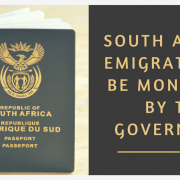
SOUTH AFRICAN EMIGRATION TO BE MONITORED BY THE GOVERNMENT
/in Archived, News /by Marisa JacobsThis will enable the Government to keep track of the South Africans abroad and attempt the curb of the high emigration rate in South Africa.
This comes as data published in the white paper indicate that 520,000 South Africans became expats between 1989 and 2003. Of these, 120,000 had professional qualifications, making up over 7% of all of the country’s professionals.
The white paper also noted that these emigration figures have increased by 9% each subsequent year and that a greater number of skilled black South Africans were also choosing to emigrate.
Read more here
As published by businesstech.co.za
Permanent Residency Applications Submitted prior to June 2014 – to be re-submitted electronically BEFORE END JUNE 2017
/in Archived, News /by Marisa JacobsA solution pertaining to the above has been provided by the Department, whereby any individual who applied for Permanent Residence prior to 02 June 2014 and whose particulars appear on the list published in the National Government Gazette, may re-submit their Permanent Residency applications at their earliest convenience.
For the list published on 17 March 2017 by the National Government Gazette No. 40691, please click here (from page 35 to 95).
FAILURE TO RE-SUBMIT YOUR APPLICATION, THE DEPARTMENT WILL CONSIDER YOUR APPLICATION CLOSED.
To view the full notice published by the Department of Home Affairs click here.
Should you wish to acquire any assistance pertaining to the above, please do not hesitate to contact us at contact@workpermitsouthafrica.co.za.
What to Expect from Minister Malusi Gigaba | Lessons from Immigration and Work Permit Professionals
/in Archived, News /by Marisa JacobsStreamlined Work Visas
Minister Malusi Gigaba was appointed as Minister of Home Affairs in May 2014. We have no specialist knowledge on his relationship with his former employees, however, dealing with the Department of Home Affairs on work visas daily, we have seen the positive transformation with him at the helm. The Department now have better processes, legislative direction and drastically improved administration (except perhaps in the case of an application for a “general” work visa which requires the Department of Labour’s blessing). Our sense is that the Minister has created a space for competent home affairs officials to get things done.
Some recent initiatives include the formal introduction of permanent residency for graduates, the introduction of VFS to outsource administration and a White Paper to completely revamp work visas and migration etc. There is, of course, unfinished business such as with regard to the law that obliges South African passport holders to travel with their passport in and out of South Africa and how South Africa should be dealing with the thorny matter of dual passport holders. However, the bottom line is that the Minister has done plenty in a short period of time and where many before him have failed dismally. As work visa and immigration specialists, we are sad to see him go and he leaves a much more robust Home Affairs department.
Some Negatives
Some of the less favourable examples of Gigaba’s legacy are, of course, the requirement of abridged birth certificates for children travelling to South Africa and the more recent inspections to ensure South African businesses comply with the requirement to employ a minimum of 60% South African citizens. In particular, how the abridged birth certificate issue was handled has raised many concerns and may have cost our country plenty.
Onto Finance and Tax
So, what does the Minister’s appointment mean for National Treasury and SARS, both being structurally sounder than the Home Affairs department which Minister Gigaba inherited? As he did with Home Affairs, the Minister will probably allow the good guys to get on with their work. There may be some winning over to do, as he comes in with a negative presumption on the reason for his appointment, however, if you consider where Home Affairs was a couple of years ago, compared to where it is now, I have more hope than most.
A bigger concern will be whether he intends to adopt any controversial positions. As he is now dealing with economic and tax policy, the cost will be far greater if the Minister should allow another abridged birth certificate type debacle. That matter has shown us that he takes principled policy decisions and drives them hard even where there is good evidence that a contrary view would be preferred.
The Minister has achieved much at an early age, which will hopefully come with the ability to learn from one’s mistakes and make a good recovery thereafter. He might even connect the long-waited dots between tax policy and immigration matters.
Rattling Some Cages
More accurate registering and tracking of foreign nationals was one of the Minister’s landmark initiatives while at the helm of the Home Affairs department. Sharing that ability with SARS to ensure everyone pays their taxes will no doubt make a difference to our tax collection. Coming down on employers of foreign nationals who do not play by the rules was something important to him, and now with the taxman doing his bidding, he should arrive with more purpose. On the passport matter, South African passport holders who contribute nothing to our fiscus and feel they owe the country nothing (even though they use our passport) may also find themselves on the wrong side of the Minister, especially with some recent policy announcements on expatriate taxes. Making a tax check on passport renewals is an easy step with the systems he has introduced.
I may be one of the few positive voices, but our work permit business has transformed under his stewardship, mainly due to the creation of an environment which looks after the ones who align themselves with good practice and compliance. Obviously, I will have to chin-up if by publishing there has been a presidency change, but if I can make one request to the new kingpin, it is that he transfer Minister Gigaba back to Home Affairs.
By Marisa Jacobs
Director – Head of Immigration and Mobility
Xpatweb
FIND US
Johannesburg
17 Eaton Avenue,
Bryanston, Johannesburg,
Gauteng, 2191
South Africa
George
55 York Street
Dormehls Drift
George, 6529
South Africa
CONTACT US
Telephone:
South Africa: 011 467 0810
Postal:
PO BOX 35046
Northcliff
2115
IN THE NEWS
- Another Positive Move To Attract More Tourists To SA
- Bringing in the Bomb Squad at Home Affairs
- How Home Affairs’ Immigration Reforms Could Drive SA’s Growth in 2025
- Phindiwe Mbhele on Remote Work Visa: Splendid Cape Town is wooing more and more digital nomads
- Cape Town Shines, and So Does South Africa’s New Critical Skills Visa Overhaul